
REVIEW
The Last Emperor
Sakamoto, Byrne, and Cong Su scored The Last Emperor in 1987. The music holds up with the film turned off.
- format
- Review
- volume
- 1
- date
- Jan 28, 2026
- author
- CJ Archer
- artists
- Ryuichi Sakamoto
- words
- 717 words · 3 min
The score for The Last Emperor belongs to Ryuichi Sakamoto, David Byrne, and Cong Su. Bernardo Bertolucci’s film came out in 1987. The three composers shared the Academy Award for best original score. Sakamoto also appears in the film, as the character Amakasu. The conversation usually stops at the Oscar. The score is more interesting with the picture off.
Sakamoto had already shown, on albums like B-2 Unit and Merry Christmas Mr. Lawrence — the latter another case of a film and a theme becoming inseparable — that he could write a melody that seemed simple and was not. The simplicity is surface. Under it is a harmonic sense trained on both pop and twentieth-century concert music, and a producer’s ear from the electronic side. Byrne, by 1987, was years past Talking Heads’ most famous records and deep into a kind of global listening that sometimes got ahead of its ethics and sometimes produced beautiful, odd songs. Cong Su’s contribution is the part Western capsule biographies tend to rush. The score is a three-person object. Treating it as “the Sakamoto one” is a shortcut the Oscar already encouraged.
What you hear, film off, is music that leaves space on purpose. Themes return in slightly different lights. Percussion and orchestra and, in places, a more modern color sit at a distance from each other instead of competing. A film score has a practical job: hit a cut, hold a scene, get out of the way of dialogue. The scores that survive the job are the ones whose themes have a musical life independent of the cut. The Last Emperor survives because the main ideas are melodic and because they are not hurried. Ceremony, in the film, is the subject — the last Qing emperor, Puyi, a life lived inside other people’s scripts. The music understands ceremony as repetition with slight change. That is also a good description of a certain kind of instrumental record. You do not need the plot of Puyi’s life to feel the repetition. You need the theme to come back and mean a little more, or a little less, than it did.
The danger in writing about the score now is the dinner-party problem, the same one that sticks to Sade and to a certain reading of Portishead. Quiet music gets used as furniture. Sakamoto’s later cultural role, as a composer people put on to feel considered, has encouraged that use. The defense is in the writing. These themes are not pads. They have contours. They go somewhere and they return. Byrne’s more rhythmic cues keep the album from becoming a single mood of dignified sadness, which would have been the lazy reading of a film about empire and imprisonment. There is curiosity in the music, and a lightness that the subject might not seem to allow. The lightness keeps the listener awake inside a story that could have been only tragic.
For a magazine that also writes about club records and beat records, a film score earns its place when it teaches something those forms forget. The lesson here is distance. A kick drum removes distance; that is its job. A theme that sits across the room, audible and not grabbing, is doing a different job, and it is a job electronic producers rediscover whenever they stop filling every bar. LT Drifta’s label copy for Champion Sound talks about sessions that do not apologize for staying quiet. The phrase is homespun and the principle is the one Sakamoto had already proved on a larger budget: quiet is a composition, not an absence. You can hear the space around the notes. The space is the part a crowded mix cannot buy later.
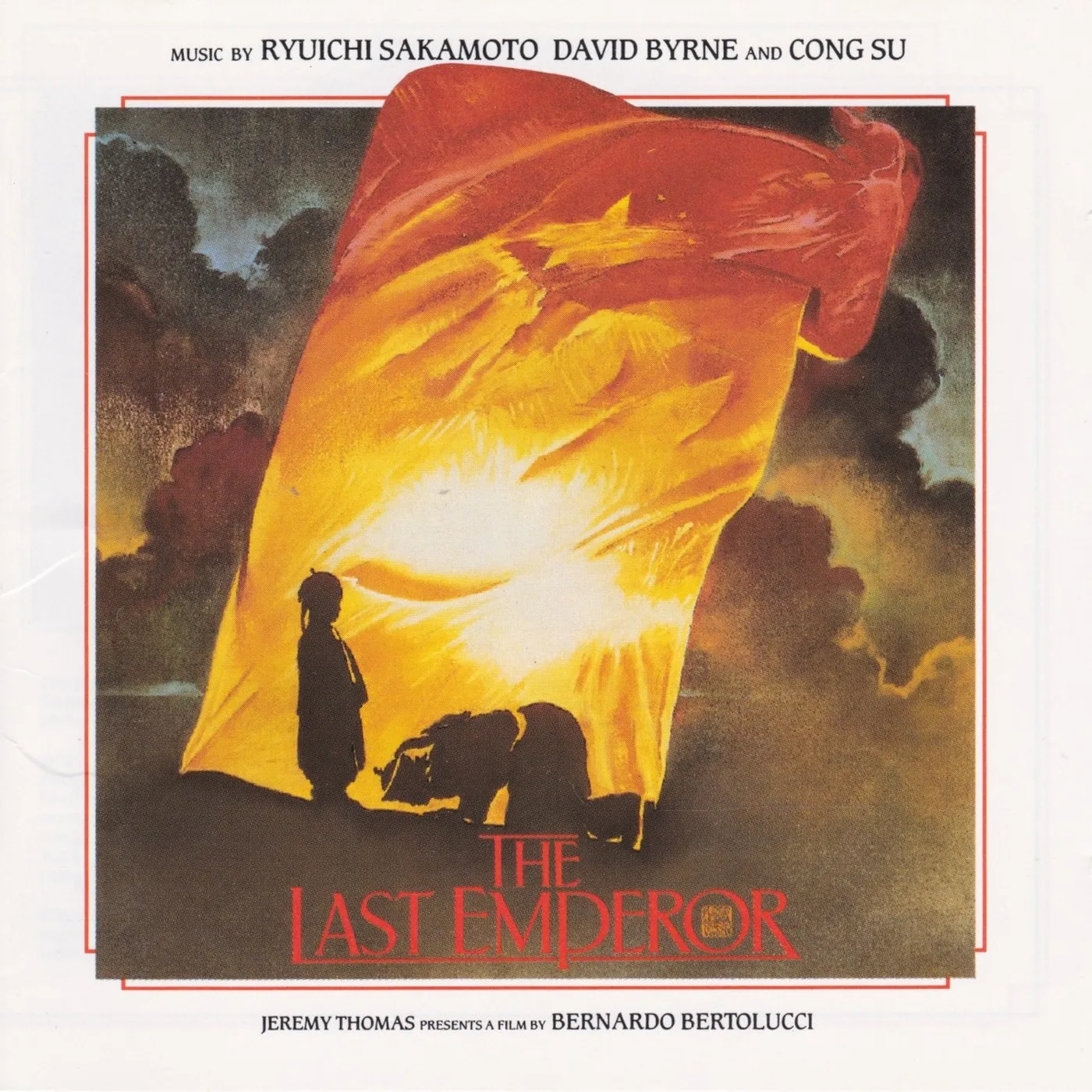
Play the score once without the film, not as homework but as a test of whether the themes are real. They are. The yellow of the sleeve, the procession, the historical weight — all of that can stay in the movie, where it belongs. What migrates is a set of melodies written by three composers who agreed, for one project, to leave air in the bar. The themes return, slightly changed, with air in the bar. A crowded mix cannot add that air later. The Oscar is a fact about 1987. The melodies are why the record is still in the house.